What Are China Top 10 Hot Rolled Steel Plate Manufacturers?
Choosing a reliable Hot Rolled Steel Plate manufacturer requires more than comparing factory size or advertised prices. Buyers must examine steel grades, rolling capacity, quality control, delivery performance, and technical support. A plate may look uniform under warehouse lighting, yet its internal quality matters more during welding, bending, or heavy-load service.
Lakshmi Mittal, a widely recognized steel industry leader, has said, “Steel is the backbone of the modern world.” That observation remains practical today. Hot rolled plates support bridges, pressure vessels, mining equipment, shipbuilding, construction machinery, and energy projects. Their performance depends on controlled heating, accurate thickness, stable chemical composition, and careful cooling. Small differences can become costly problems.
This article introduces China’s top 10 Hot Rolled Steel Plate manufacturers through a buyer-focused perspective. The evaluation considers production scale, product range, certifications, export experience, inspection systems, and customer communication. It also considers whether a supplier can provide mill test certificates, ultrasonic testing, surface inspection, and traceable heat numbers. Useful details matter, including plate dimensions, edge condition, mill scale, and packing quality.
No ranking is perfect. Public information can be incomplete, and a manufacturer strong in ship plate may not suit an infrastructure project. Price alone can mislead. A lower quotation may exclude testing, cutting, coating, or dependable after-sales support. Buyers should verify current certifications and request samples before making a final decision. This guide offers a practical starting point, but careful technical review is still necessary. Some conclusions may need revision as capacity, technology, and market conditions change.
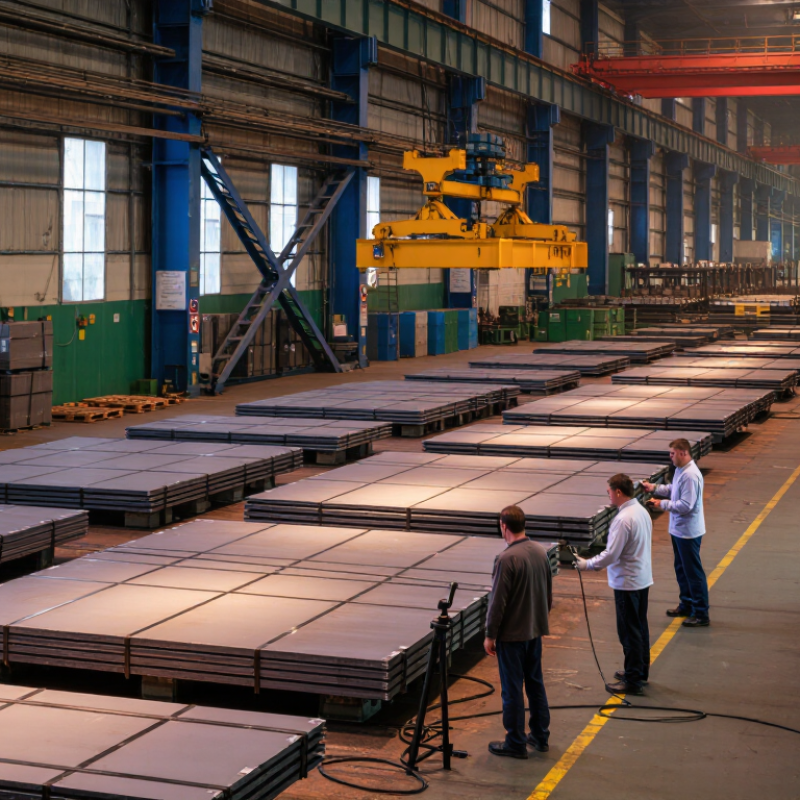
Definition and Scope of China’s Hot Rolled Steel Plate Industry
China’s hot rolled steel plate industry covers steel plates formed above their recrystallization temperature. The process uses heated slabs, rolling mills, controlled cooling, and cutting lines. Products commonly range from general structural plate to high-strength and wear-resistant grades. They serve construction, bridges, machinery, shipbuilding, energy equipment, and heavy transport.
The “top 10 manufacturers” should not mean the largest output alone. A reliable assessment also examines furnace capacity, rolling accuracy, chemical control, inspection systems, delivery records, and technical support. In practice, experienced buyers compare mill certificates, thickness tolerance, surface condition, yield strength, and impact performance. Regional supply networks matter too, especially for large plates and urgent orders. Still, rankings can be imperfect. Public data may be incomplete, and production volume does not always prove consistent quality.
Tips: Ask for recent test reports, not only catalog claims. Confirm the applicable standard and inspection method before ordering. Check plate flatness under proper lighting. Review packaging, marking, and traceability details. For critical projects, request sample testing or third-party inspection. Small errors become expensive later. Also compare lead time against actual production capacity, because a low quoted price may hide scheduling risks. When defining the industry’s scope, include both integrated steel producers and specialized plate processors, but separate traders from original manufacturers.
Ranking Criteria for China’s Top Hot Rolled Steel Plate Manufacturers
Ranking China’s hot rolled steel plate manufacturers should begin with verified production capability, not advertising claims. The World Steel Association’s World Steel in Figures 2024 reports China produced about 1,019.1 million tonnes of crude steel in 2023. That scale creates strong supply depth, but it does not prove consistent plate quality. A practical ranking should examine rolling mill capacity, plate thickness ranges, monthly output stability, and delivery performance. Customer trial orders often reveal more than brochures.
Quality evidence deserves heavier weighting. Reviewers should compare mill certificates, heat numbers, chemical analysis, tensile strength, impact values, flatness, and thickness tolerances. GB/T and ASTM compliance should be confirmed through independent testing records. ISO 9001 certification supports process control, while ISO 14001 can indicate environmental management. The OECD’s Steel Market Developments reports continue to highlight global overcapacity risks, so capacity alone can mislead buyers. Energy use and emissions data matter too. The World Steel Association’s sustainability indicators provide useful benchmarks for evaluating reporting quality. Traceability is essential.
A strong ranking might assign 30% to product quality, 20% to delivery reliability, 15% to technical service, and 15% to financial stability. The remaining points can cover sustainability and export experience. These weights are not universal. Project requirements change them. Site audits, sample testing, and reference checks should validate every score, because published data may be incomplete or several years old.
What Are China’s Top 10 Hot Rolled Steel Plate Manufacturers?
Ranking Criteria for China’s Top Hot Rolled Steel Plate Manufacturers
The evaluation model assigns the greatest importance to product quality, standards compliance, production capacity, and delivery reliability. The weighting reflects common industrial purchasing considerations for hot rolled steel plates, including mechanical performance, dimensional consistency, certification, supply capability, and customer service. The percentages are editorial criteria weights rather than company-specific performance scores.
Products, Production Capacity, and Quality Certifications
China’s top 10 hot rolled steel plate manufacturers are usually assessed through product coverage, usable capacity, and verified quality systems. The World Steel Association reported China’s crude steel output at about 1,005 million tonnes in 2024. However, crude steel output is not plate capacity. This distinction matters.
Leading producers commonly supply carbon steel, low-alloy plate, high-strength structural plate, weathering steel, shipbuilding plate, pressure-vessel plate, and wear-resistant grades. Their plate lines may range from medium-gauge products to heavy plates exceeding 300 millimetres. Capacity figures should be checked against furnace size, rolling-mill width, annual plate output, and delivery records. Public figures can be inconsistent.
Quality evidence is more useful than a large number. ISO 9001 supports controlled production and traceability, while ISO 14001 and ISO 45001 address environmental and occupational systems. Export-oriented mills may also provide EN 10204 3.1 inspection certificates, classification approvals, or compliance with ASTM, EN, GB/T, and API-related specifications. The ISO Survey 2023 recorded more than one million ISO 9001 certificates worldwide, showing its broad adoption, but certification alone does not prove stable plate performance.
Buyers should review heat numbers, ultrasonic testing results, tensile data, impact-test temperatures, and mill inspection reports. CISA industry statistics can help benchmark Chinese steel production, yet they do not independently verify every manufacturer’s capacity. That gap deserves attention. A practical shortlist combines audited documents, recent test reports, sample orders, and delivery performance. Availability is often less impressive than brochures suggest.
How to Evaluate and Select a Hot Rolled Steel Plate Manufacturer
When comparing China’s top 10 hot rolled steel plate manufacturers, do not trust rankings alone. A reliable selection begins with the plate’s intended service: structural frames, pressure equipment, shipbuilding, or heavy machinery. Ask for grade options, thickness tolerance, width limits, impact testing, and delivery condition. An experienced supplier should explain why a certain carbon or alloy composition fits your application. Technical confidence matters more than sales language. Good answers include test methods, acceptance limits, and clear references to recognized standards.
Request recent mill test certificates, heat numbers, chemical analysis, tensile results, and ultrasonic inspection records. The heat number should follow the plate from production to packing. Check whether the manufacturer controls reheating, rolling temperature, cooling, leveling, and cutting. These steps affect grain structure, flatness, residual stress, and weldability. Visit the works when possible, or arrange a live production audit through an independent inspector. A clean showroom proves little. One overlooked calibration record can change your view.
Compare sample plates, not only quotations. Measure thickness at several points, inspect edges, and review surface scale after shot blasting or treatment. Confirm packaging, export documents, production capacity, lead times, and claim procedures in writing. Ask how the supplier handles nonconforming plates and delayed shipments. A low price may hide weaker inspection or inconsistent delivery. I have seen technically strong offers fail because communication was vague. Leave room for doubt, and test the details before committing to a large order.
What Are China Top 10 Hot Rolled Steel Plate Manufacturers? - How to Evaluate and Select a Hot Rolled Steel Plate Manufacturer
| Rank |
Anonymous Manufacturer Profile |
Annual Plate Capacity |
Typical Thickness Range |
Typical Width Range |
Main Product Grades |
Applicable Standards |
Quality Certifications |
Export Capability |
Typical Lead Time |
Evaluation Score |
| 1 |
Manufacturer Profile 01 |
3.0–5.0 million tonnes/year |
3–250 mm |
1,500–4,000 mm |
Structural, pressure-vessel, shipbuilding, weathering steel |
ASTM, EN, JIS, GB/T, API |
ISO 9001, ISO 14001, ISO 45001 |
Regular container and bulk shipment programs |
20–35 days |
94/100 |
| 2 |
Manufacturer Profile 02 |
2.5–4.5 million tonnes/year |
4–220 mm |
1,500–3,800 mm |
Carbon steel, low-alloy steel, bridge and construction plate |
ASTM, EN, JIS, GB/T |
ISO 9001, ISO 14001 |
Strong experience in Asia, the Middle East and Africa |
25–40 days |
92/100 |
| 3 |
Manufacturer Profile 03 |
2.0–4.0 million tonnes/year |
4–200 mm |
1,500–3,600 mm |
Ship plate, offshore plate, structural and high-strength steel |
ASTM, EN, JIS, GB/T, classification rules |
ISO 9001, ISO 14001, ISO 45001 |
Project-based export and mill certification support |
25–45 days |
91/100 |
| 4 |
Manufacturer Profile 04 |
1.5–3.5 million tonnes/year |
3–180 mm |
1,500–3,200 mm |
General structural, boiler, pressure-vessel and pipeline plate |
ASTM, EN, JIS, GB/T, API |
ISO 9001, ISO 14001 |
Established trading and distributor network |
20–40 days |
89/100 |
| 5 |
Manufacturer Profile 05 |
1.2–3.0 million tonnes/year |
4–160 mm |
1,500–3,000 mm |
Construction, machinery, mining and wear-resistant plate |
ASTM, EN, JIS, GB/T |
ISO 9001, ISO 14001 |
Flexible container loading and custom packaging |
25–45 days |
87/100 |
| 6 |
Manufacturer Profile 06 |
1.0–2.5 million tonnes/year |
3–150 mm |
1,500–2,800 mm |
Carbon, low-alloy, boiler and pressure-vessel steel plate |
ASTM, EN, JIS, GB/T |
ISO 9001, ISO 14001, ISO 45001 |
Small-to-medium batch export capability |
30–50 days |
85/100 |
| 7 |
Manufacturer Profile 07 |
0.8–2.0 million tonnes/year |
4–140 mm |
1,500–2,600 mm |
Structural, bridge, agricultural machinery and industrial plate |
ASTM, EN, JIS, GB/T |
ISO 9001 |
Primarily regional export with project orders |
30–50 days |
82/100 |
| 8 |
Manufacturer Profile 08 |
0.6–1.8 million tonnes/year |
3–120 mm |
1,500–2,500 mm |
Commercial structural plate, machinery plate and high-strength grades |
ASTM, EN, JIS, GB/T |
ISO 9001, ISO 14001 |
Distributor-led international sales |
30–55 days |
80/100 |
| 9 |
Manufacturer Profile 09 |
0.5–1.5 million tonnes/year |
4–100 mm |
1,500–2,400 mm |
General carbon steel, construction and fabrication plate |
ASTM, EN, JIS, GB/T |
ISO 9001 |
Suitable for standard export specifications |
35–55 days |
77/100 |
| 10 |
Manufacturer Profile 10 |
0.3–1.2 million tonnes/year |
3–80 mm |
1,500–2,200 mm |
Standard structural, machinery and general-purpose plate |
ASTM, EN, JIS, GB/T |
ISO 9001 |
Best suited to consolidated and repeat orders |
35–60 days |
74/100 |
|
Evaluation factors include production scale, dimensional range, applicable standards, quality management, export experience, delivery reliability and technical support. Capacity, lead time and product availability should be verified against the supplier’s current mill certificate, inspection records and commercial quotation before purchase.
|





 +86 18865111877