Choosing Hot Rolled Steel Carbon Plate in 2026 requires more than comparing prices per ton. The correct plate must match the project’s load, welding method, forming needs, environment, and delivery schedule. A bridge fabricator may prioritize yield strength and certified toughness. A machinery builder may need predictable cutting, bending, and dimensional consistency. Thickness matters, but it is not the whole decision.
Professor Harry Bhadeshia, a respected metallurgist, states, “Steel is an alloy of iron and carbon.” That simple sentence deserves attention. Carbon content influences strength, hardness, weldability, and response to heat. Higher strength can sound attractive, yet excessive carbon may complicate welding and increase cracking risks. The mill scale may also hide surface defects. Inspect it under clear light. Check plate edges, flatness, thickness tolerance, heat numbers, and test certificates.
Reliable selection begins with verified requirements. Confirm the applicable ASTM, EN, or project specification before ordering. Compare chemical composition, yield strength, tensile strength, impact performance, and ultrasonic testing requirements. Ask the supplier how the plate was rolled, inspected, stored, and protected from moisture. Traceability matters.
Small details matter.
A plate can look acceptable and still fail a demanding fabrication process. I would not trust a product based only on a familiar grade name. Supplier reputation helps, but documented evidence is stronger. In practice, the perfect choice may not exist. The better choice balances performance, availability, fabrication risk, inspection quality, and total lifecycle cost.
Hot rolled carbon steel plate is a flat steel product formed while the material is heated above its recrystallization temperature. Large rollers reduce the slab into a planned thickness. The process is efficient, but it leaves dark mill scale and less precise dimensions than cold rolling. The surface may feel slightly rough. That is normal.
Carbon steel contains carbon as its main strengthening element, with small amounts of manganese, silicon, and other controlled elements. Its performance depends on grade, thickness, heat treatment, and manufacturing quality. In practical projects, plates may become beams, brackets, frames, storage tanks, or machine bases. A thick plate can resist heavy loads, yet it may need preheating before welding. Welding procedure matters.
For a 2026 purchase, check the material certificate, chemical analysis, yield strength, tensile strength, impact requirements, and dimensional tolerances. Ask how flatness and surface defects were inspected. Visible scale is not automatically a defect, but deep seams, laminations, or cracks deserve rejection. Measure thickness at several points, not only near the edge. This small step is often skipped. I have seen drawings assume perfect flatness, while real plates needed straightening. That oversight can increase fabrication time and cost. Also consider cutting loss, transport limits, and the corrosion protection required after fabrication.
Compare hot rolled carbon and low-alloy structural plate grades by their minimum specified yield strength. ASTM A36 is a general-purpose structural steel, while A572 Grade 50, A588 Grade A, and A709 Grade 50 provide a higher nominal yield-strength level of 50 ksi (345 MPa).
Values are minimum specified yield strengths for common plate thickness ranges and may vary with product thickness, heat treatment, chemistry, and the applicable ASTM specification. Always verify the current mill certificate and standard.
Carbon grade is the starting point when choosing hot rolled steel plate, but it is not the whole decision. Low-carbon grades usually contain up to about 0.25% carbon and offer good weldability, bending performance, and ductility. Medium-carbon grades often range from 0.25% to 0.60%, providing higher strength with reduced formability. High-carbon grades exceed roughly 0.60% and can deliver greater hardness, although welding becomes more demanding. Exact limits vary by applicable standard.
Mechanical properties show how the plate behaves under load. Yield strength indicates when permanent deformation begins. Tensile strength measures the maximum pulling force before failure. Elongation reflects ductility during a tensile test. Hardness can help assess wear resistance, but it should not replace certified tensile data. A plate with high strength may be unsuitable for a welded frame if its elongation is too low.
Check the material certificate, thickness, heat number, and test temperature before ordering. Thickness affects cooling, strength distribution, and bending behavior. Heat treatment or controlled rolling may also change the final performance of the same carbon range. In a workshop, a plate that looks sound can still crack beside a weld. That detail is easy to overlook. My practical rule is to match the grade, strength, and fabrication method together, then verify results against the requested standard. A simple grade chart helps, but it is not perfect.
Choosing hot rolled carbon plate in 2026 starts with the load, not the catalog. World Steel Association data recorded 1.89 billion tonnes of crude steel production in 2023. That scale creates many grades, sizes, and quality levels. For structural frames, A36 or an equivalent grade may fit. Higher-strength grades can reduce weight, but welding and forming become less forgiving.
Measure the working envelope carefully. Choose plate length and width that reduce joints and cutting waste. Leave enough access for welding, lifting, and inspection. A 10 mm plate may suit brackets, base plates, or light frames. Heavier machinery often needs 16 mm, 20 mm, or more. Do not select thickness by habit. Check calculated stress, buckling, impact conditions, and corrosion allowance. ASTM A6/A6M provides dimensional and mass tolerances, but actual mill tolerances still require inspection.
Surface finish deserves attention. Hot rolled plate normally carries mill scale, with a dark, uneven appearance. It works well for painted structures after proper cleaning. Shot-blasted or pickled surfaces improve coating preparation, yet they add cost and may expose small defects. ISO 8501-1 classifies preparation grades such as Sa 2½, commonly specified before protective coating. A practical specification should state roughness, cleanliness, flatness, and edge condition. I have seen buyers overpay for polished surfaces that later disappeared under paint. That choice was not entirely wrong, but it was poorly matched to the service environment.
How to Choose Hot Rolled Steel Carbon Plate in 2026?
Standards should be the first filter when selecting hot rolled carbon plate. ASTM A36, ASTM A572, and EN 10025 define different strength, chemistry, and testing requirements. Do not compare grades by price alone. World Steel Association’s World Steel in Figures 2024 reports 1,888.2 million tonnes of crude steel production in 2023. Such volume increases the importance of traceability and consistent documentation. Ask for a material test certificate showing heat number, chemical composition, yield strength, tensile strength, elongation, and thickness tolerance. Small details matter.
Certification is useful, but it is not automatic proof of plate quality. ISO 9001 certification indicates controlled quality processes, not guaranteed performance for every plate. Independent inspection can verify dimensions, surface defects, ultrasonic soundness, and test results against the purchase standard. For welded structures, review carbon equivalent and impact toughness requirements, especially in cold service. EN 10204 3.1 documentation can provide traceable inspection results from the producer. For higher-risk projects, a 3.2 certificate and third-party witness may be more appropriate.
A certificate can still contain errors. Check heat numbers physically. Confirm the laboratory’s accreditation and test date. Sampling location also matters, because one coupon may not represent an entire plate. The better choice combines a recognized standard, verifiable certification, and testing suited to the actual load, temperature, and welding method. Cheap plates often become expensive during fabrication. Sometimes, the specification itself needs reconsideration.
| Selection Dimension | Relevant Standard or Document | What It Defines or Verifies | Reliable Data or Typical Requirement | Effect on Plate Selection | Priority |
|---|---|---|---|---|---|
| Application and Design Load | Project specification, design code, structural calculations | Required yield strength, tensile strength, stiffness, fatigue resistance, and service conditions | Choose the lowest grade that safely meets the calculated design loads while considering fabrication, temperature, corrosion, and fatigue requirements. | Prevents over-specification, excessive cost, and unsafe substitution of a lower-strength grade. | Critical |
| Common Structural Grade | ASTM A36/A36M | Requirements for carbon structural steel plates, shapes, and bars | Typical minimum yield strength is 36 ksi (approximately 250 MPa), with tensile strength requirements defined by the applicable thickness and product specification. | Suitable for many general structural, welded, and fabricated components when the design does not require higher strength or special impact performance. | High |
| Higher-Strength Structural Grade | ASTM A572/A572M, Grade 50 | High-strength, low-alloy structural steel requirements | Grade 50 specifies a minimum yield strength of 50 ksi (approximately 345 MPa); chemistry and toughness requirements depend on the grade and supplementary requirements. | Can reduce plate thickness or structural weight, but welding procedure, forming limits, and impact requirements must still be checked. | Critical |
| European Structural Grade | EN 10025-2 | Non-alloy structural steel grades and delivery conditions | Common grades include S235 and S355. The minimum yield strength is thickness-dependent; for example, S235JR and S355JR are commonly specified for products up to 16 mm thickness at 235 MPa and 355 MPa respectively. | Use the exact grade, subgrade, thickness range, and delivery condition shown in the purchase specification and mill certificate. | Critical |
| Japanese Structural Grade | JIS G 3101, SS400 | Rolled steels for general structure | SS400 is primarily controlled by tensile-strength requirements and thickness-dependent yield requirements; the applicable JIS edition and product thickness must be confirmed. | Appropriate when the project accepts JIS material. Do not assume that SS400 is automatically equivalent to ASTM A36 or EN S235 without a documented comparison. | Medium |
| Chemical Composition | Applicable product standard; ASTM A751 or EN 10204 supporting documentation | Carbon, manganese, silicon, phosphorus, sulfur, and any specified alloying elements | Chemical limits vary by grade, thickness, heat, and standard. The certificate should identify the heat number and report actual ladle analysis values. | Controls weldability, strength, toughness, forming behavior, and susceptibility to cracking. Lower carbon equivalent generally supports easier welding. | Critical |
| Carbon Equivalent and Weldability | ISO 2553 for welding symbols; IIW carbon-equivalent practice; project welding procedure | Relationship between chemistry, hardenability, preheating, and hydrogen-cracking risk | Carbon equivalent should be calculated from the certified heat analysis using the formula required by the project or applicable standard. A higher value may require preheating or controlled heat input. | Important for thick plates, restrained joints, low-temperature fabrication, and critical welded structures. | Critical |
| Mechanical Tensile Test | ISO 6892-1 or ASTM A370 | Yield strength, tensile strength, elongation, and test method | Test results must meet the selected material standard at the specified thickness. Test direction, specimen location, and gauge length affect reported elongation. | Confirms that the supplied plate has the required strength and ductility rather than relying only on the nominal grade name. | Critical |
| Impact Toughness | ISO 148-1 or ASTM A370; EN 10025 subgrades | Resistance to brittle fracture, commonly measured by Charpy V-notch impact testing | Impact requirements depend on temperature and material subgrade. EN subgrades such as JR, J0, and J2 correspond to different Charpy test temperatures and energy requirements. | Essential for cold climates, dynamically loaded structures, pressure-related applications, and thick or highly restrained welded joints. | Critical |
| Plate Thickness and Tolerances | ASTM A6/A6M or EN 10029 | Permissible variations in thickness, width, length, flatness, and shape | Thickness tolerance is not identical across standards and may depend on nominal thickness, width, and ordered tolerance class. EN 10029 includes tolerance classes for thickness and flatness. | Specify nominal dimensions and tolerance class before ordering, especially for machined parts, laminated structures, and automatic fabrication lines. | High |
| Surface Condition | ASTM A6/A6M, EN 10163, or project surface-quality specification | Surface imperfections, repair limits, scale condition, and permissible defects | Hot-rolled plate normally has mill scale. Surface-quality classes may define limits for cracks, seams, slivers, laminations, and repair methods. | Select a tighter surface-quality class when the plate will be painted, machined, bent, exposed, or used in fatigue-sensitive service. | High |
| Ultrasonic Examination | EN 10160 or ASTM A435/A578, as specified | Internal discontinuities such as laminations, inclusions, and planar defects | Acceptance level, scanning coverage, test direction, and reporting requirements must be stated. Ultrasonic testing is supplementary unless required by the product standard or purchase order. | Recommended for thick plates, welded pressure-containing parts, bridge components, crane structures, and other applications sensitive to lamellar tearing or internal defects. | Critical |
| Dimensional Inspection | Calibrated inspection equipment; ASTM A6/A6M or EN 10029 | Actual thickness, width, length, flatness, squareness, and edge condition | Measurements should be taken according to the applicable standard and recorded against the purchase-order tolerances. | Reduces cutting loss, fit-up problems, welding distortion, and disputes over usable plate area. | High |
| Mill Test Certificate | EN 10204, usually Type 3.1 or 3.2 | Traceability and conformity of the supplied heat or batch | Type 3.1 includes inspection results validated by the manufacturer’s authorized inspection representative. Type 3.2 adds validation by an independent inspector or purchaser-appointed representative. | Use 3.1 for standard traceability needs and consider 3.2 for safety-critical, regulated, or contractually controlled projects. | Critical |
| Quality Management Certification | ISO 9001:2015 | Supplier quality-management processes, document control, corrective action, and continual improvement | ISO 9001 certification evaluates the management system; it does not by itself prove that every plate meets a specific chemical, mechanical, or dimensional requirement. | Use it as a supplier-process indicator, but always require grade-specific certificates and inspection records. | Medium |
| Inspection Independence | Purchase specification; ISO/IEC 17020 for inspection bodies where applicable | Competence and impartiality of third-party inspection activities | Independent inspection may include document review, sampling, witnessing of tests, dimensional checks, visual examination, and ultrasonic testing. | Valuable when shipment value, safety risk, export regulation, or contractual penalties justify verification before dispatch. | High |
| Heat and Batch Traceability | EN 10204; supplier traceability procedure | Link between plate markings, shipping documents, test results, and the original steel heat | Plate identification should remain legible and match the heat number, grade, dimensions, quantity, and certificate throughout cutting and fabrication. | Mandatory for effective recalls, weld procedure qualification, nonconformance investigation, and final quality records. | Critical |
| Welding and Fabrication | ISO 15614-1; ISO 9606-1; applicable structural welding code | Qualification of welding procedures and welders | Welding qualification considers material group, thickness range, preheat, interpass temperature, heat input, consumables, and post-weld treatment. | Confirm that the selected carbon plate is compatible with the qualified welding procedure before purchase, especially for high-strength or thick material. | Critical |
| Corrosion Protection | ISO 8501-1; ISO 12944 for protective paint systems | Surface preparation, coating environment, and corrosion-protection durability | Hot-rolled carbon plate is not inherently corrosion-resistant. Mill scale, blasting grade, primer type, and corrosivity category should be defined separately. | Choose plate condition and surface preparation requirements together with the coating system and expected service environment. | High |
| Purchasing Checklist for 2026 | Project specification and current edition of the selected standard | Confirms that grade, dimensions, delivery condition, tests, certification, and documentation are aligned | State: standard and edition, grade and subgrade, thickness, dimensions, tolerance class, surface quality, impact test temperature, ultrasonic class, certificate type, marking, packing, and inspection hold points. | Creates an auditable purchase order and reduces the risk of receiving technically similar but non-equivalent material. | Critical |

In 2026, choosing hot rolled carbon plate starts with the job, not the lowest quotation. Compare thickness tolerance, yield strength, carbon content, and mill test certification. A base frame may tolerate ordinary surface scale. A welded component may not. Ask for heat numbers and traceable inspection records. I have seen buyers compare only price, then discover extra machining after uneven thickness. That mistake is easy to miss.
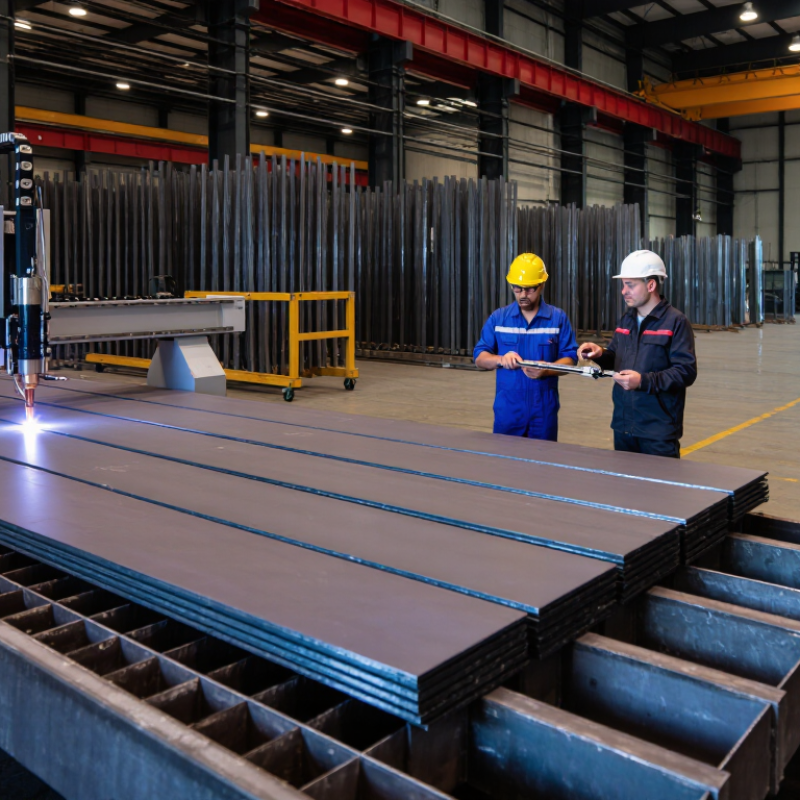
Fabrication cost includes more than cutting. Check whether the grade suits plasma cutting, drilling, bending, and welding. Higher carbon content can increase cracking risks and require preheating. Measure the cut edge. Include distortion in the estimate. A fabricator should confirm nesting efficiency, kerf loss, welding procedures, and post-weld straightening. A cheaper plate can create more labor. Spreadsheets often look too clean.
Delivery affects cash flow and production schedules. Compare lead time, packing, transport distance, minimum order, and replacement terms. Request flat, dry bundles with clear markings. During receiving, inspect dents, laminations, dimensions, and certificate details. Maintenance begins before installation. Store plates above concrete, cover them without trapping moisture, and remove loose scale before coating. Consider paint systems, drainage, abrasion, and cleaning intervals. I would also price corrosion allowance, although future exposure is easy to underestimate. Coastal air changes the calculation quickly.